
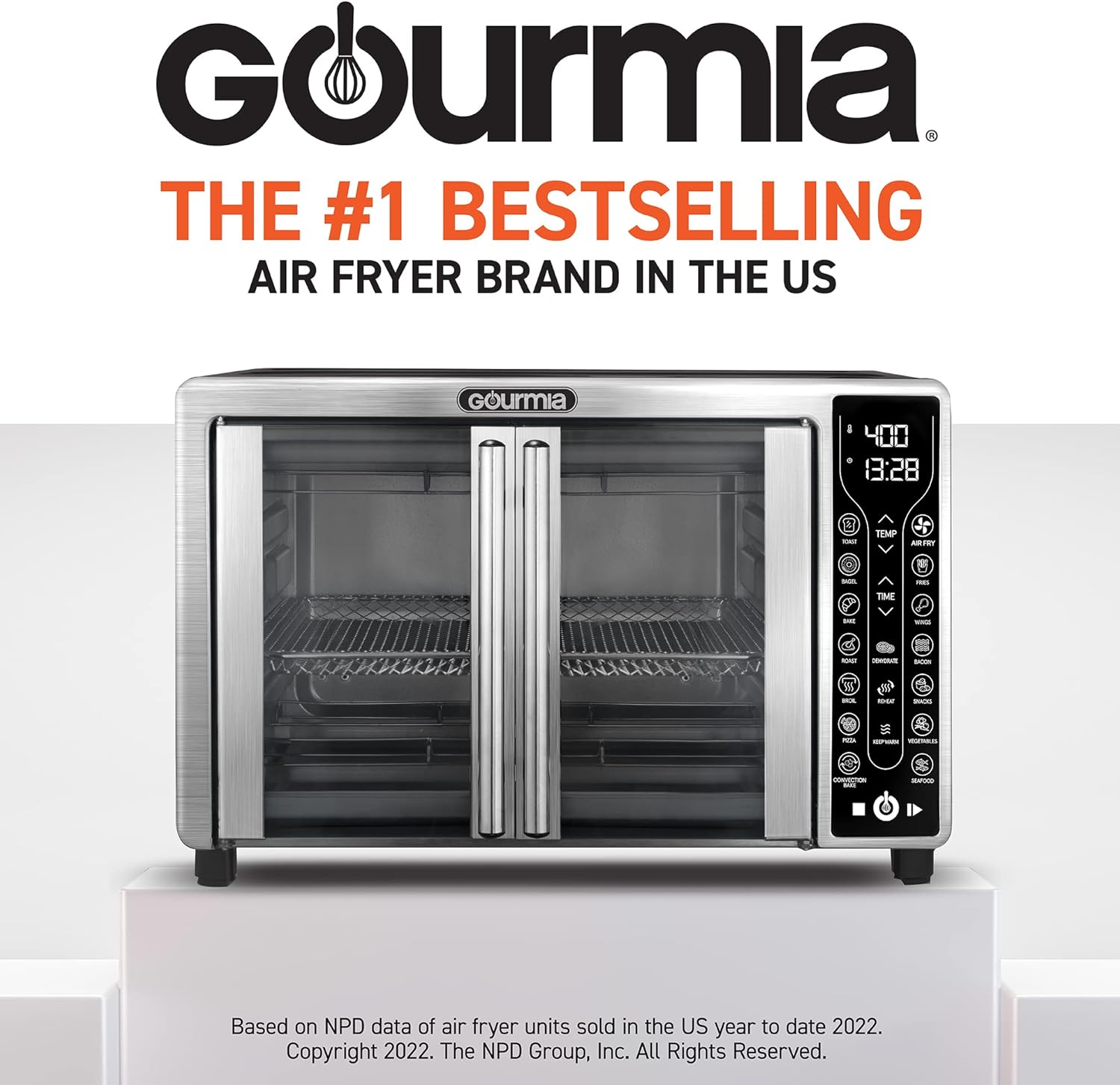
?Do you want a single countertop appliance that can crisp, roast, bake, and generally make dinner feel like less of a negotiation?
This image is property of Amazon.com.

Product overview
You are holding, in words and in potential, the Gourmia Toaster Oven Air Fryer Combo 17 cooking presets 1700W french door digital air fryer oven 24L capacity accessories, convection rack, baking pan tray recipe book GTF7460,Large,Black. The name is a small novel; the machine is a busy, efficient roommate. This section tells you what the unit promises and what it actually does for the kind of cooking you do when you have jobs, children, pets, or just a mind that prefers fewer steps.
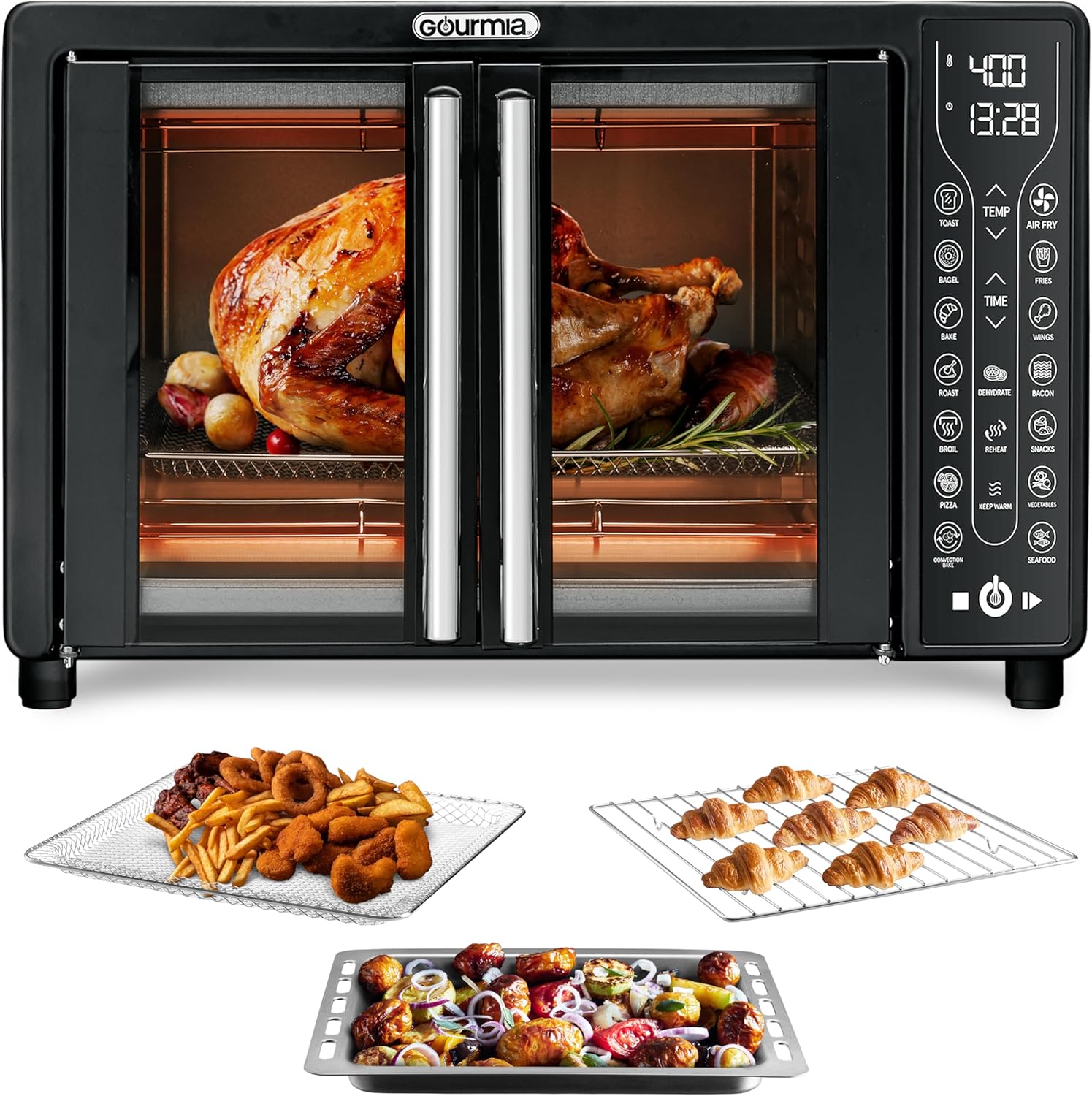
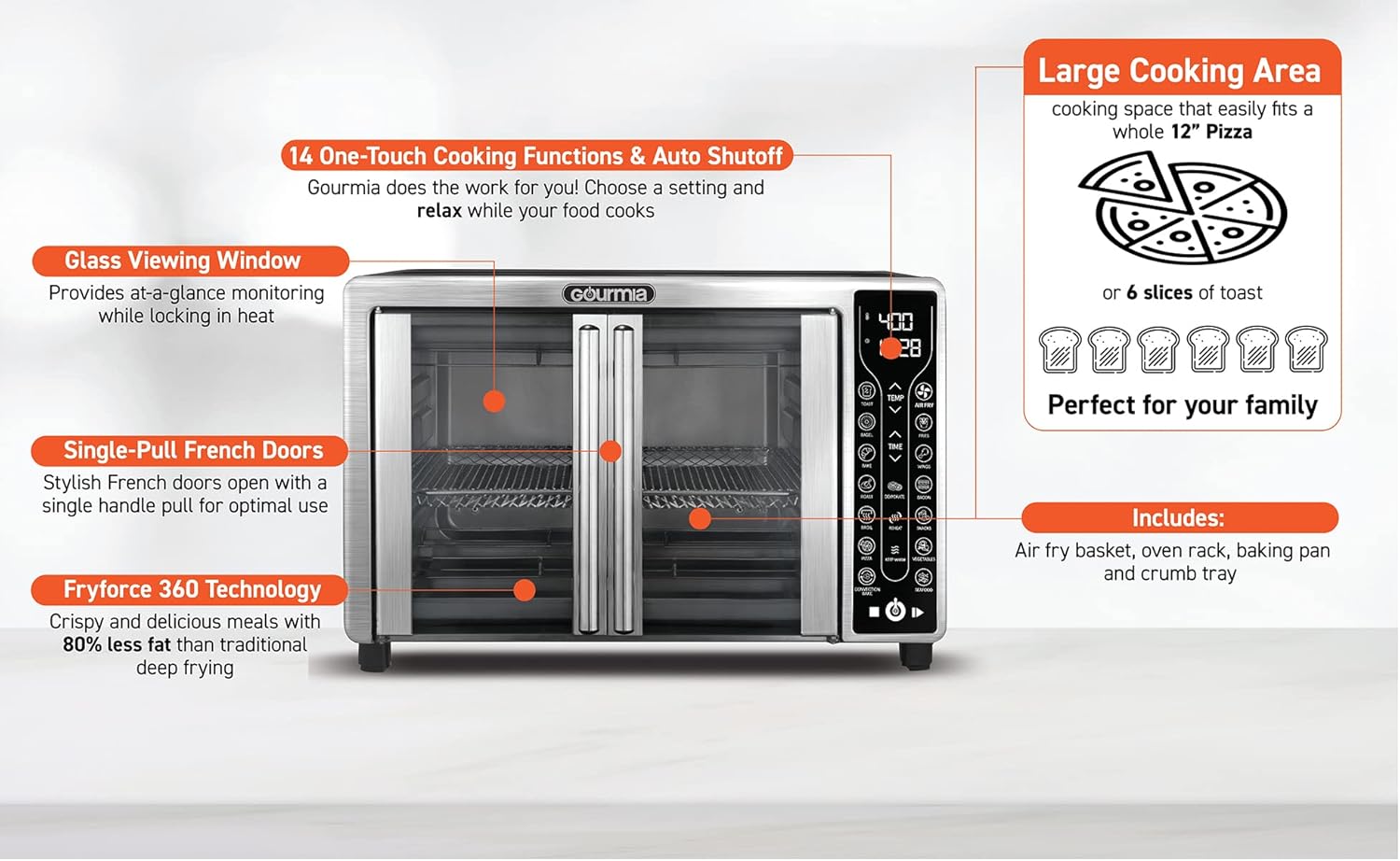
You will find a 25-quart (24L) interior that claims to accept a 12-inch pizza or a whole chicken, and a 1700W motor with FryForce Convection Technology to circulate heat for crisp results. The 17 cooking presets are an invitation to convenience—fries, roast, broil, bake, dehydrate, and toast—each intended to remove some of your guesswork and give you more time for whatever else you value.
Key features
This machine offers a compact but capacious French door design, digital controls with adjustable time (1–99 minutes) and temperature range (90°F–450°F), and a suite of accessories for immediate use. The combination of convection airflow and a high-power element aims to reduce oil dependence while increasing crispness.
You will want to pay attention to the presets, because they are both a convenience and a learning curve: they are helpful starting points, but your adjustments will make the results your own. The included recipe book is not a binding contract; think of it as a friendly suggestion.
Specifications at a glance
Below is a quick reference to help you decide whether the physical facts match your kitchen’s demands. Consult this table when you are measuring counter space, planning meals, or wondering how much difference 1700 watts makes.
| Specification | Detail |
|---|---|
| Model | Gourmia GTF7460 |
| Capacity | 24L / 25 quarts (fits 12″ pizza, 6 slices toast, whole chicken) |
| Power | 1700W |
| Presets | 17 cooking presets (air fry, bake, broil, roast, dehydrate, toast, etc.) |
| Temperature Range | 90°F–450°F (32°C–232°C) |
| Time Range | 1–99 minutes |
| Door Type | French door (dual doors, one-handed opening) |
| Included Accessories | Stainless steel fry basket, baking pan, oven rack, crumb tray, recipe book |
| Technology | FryForce Convection Airflow |
| Color / Size | Large, Black (24L capacity) |
You now have the numbers before you. They are not poetry, but they are practical; they will tell you whether the oven fits physically, electrically, and procedurally into your life.
Design and build
You will notice the French door before you notice much else: two doors that swing open together like a polite pair of hands. The exterior reads as modern and purposeful, not ostentatious, and the controls are arranged to avoid ceremony and confusion.
The workmanship is consumer-grade but solid; you will see plasticky accents where the budget name must be respected, but metal where heat and time demand it. The weight feels reassuring, not indestructible, like a tool that knows its limits without apology.
French door practicalities
The dual doors lift and unfold in a way that makes loading and removing pans less circus-like than a single heavy door angled downwards. You will appreciate being able to slide in a tray without contorting yourself toward the countertop.
That said, the doors will take some wrist space when opened, and you should be mindful of clearance above and around the unit to avoid knocking a shelf or a cabinet. The one-handed opening is a small luxury you will soon take for granted.
Materials and finish
Black enamel and brushed metal surfaces dominate the look, which keeps the machine from shouting for attention on your counter. The finish tolerates fingerprints but will reward a quick wipe to maintain a showroom temper.
Inside, the interior is easy to wipe and resists staining better than some cheap alternatives, but prolonged high-heat use and spilled grease will still demand occasional deep cleaning.

Capacity and internal layout
You are promised a 24L space—practical for a family meal, surprising when you test it. A 12-inch pizza fits; a whole chicken usually does. The crumb tray and racks slide into place with predictable satisfaction.
The internal layout is such that you can cook multiple items on different levels if you mind the airflow. You will not be able to stack every dish without affecting crispness, but the space is generous for what it is: a multifunction countertop workhorse rather than a full-sized oven.
What fits inside
Think crowd-pleasing portions rather than banquet spreads: six slices of toast at once, a 12-inch pizza, or a medium-sized whole chicken. If you are planning a casserole for ten, you are likely to get into scheduling and juggling, which can be part of the charm.
You will find the basket useful for single-level items (fries, wings), while the rack makes a good home for baking pans and roasting dishes. Learning the geometry of your own pans will save you surprises.
Rack positions and airflow
The oven has enough rack positions to let you customize cook height, but remember that the FryForce convection depends on unobstructed airflow. You will get the best crispy exterior when you allow space around what you cook.
If you crowd the interior, you will be trading speed and crispness for capacity. That is a choice you will make repeatedly until you decide on your preferred rhythm of cooking.
Controls and display
The controls are digital and deliberately simple: time, temperature, and mode buttons arranged around a clear LED display. You will not need a manual for the basics, but the preset labels require a moment of familiarization.
The user interface is minimalist in the way of someone who knows that too many options breed indecision. You will press a button, see a number, and decide whether to trust the preset or tune it.
Digital precision
The time is adjustable from 1 to 99 minutes—large enough for most roasts and full control for delicate bakes. The temperature range of 90°F to 450°F covers everything from dehydrating to broiling with authority.
This precision lets you make small adjustments that yield big improvements. A few degrees and a minute or two often separate boredom from brilliance in the results.
Buttons and user experience
Buttons are tactile without being noisy, and the display is legible without glaring. You will understand which function is active at a glance, and you will value that clarity when you have hot hands and little patience.
One quirk: the preset names can feel generic, and you will sometimes want a clearer icon for dehydrating versus toasting. You will adapt quickly enough, and if you keep the recipe book nearby, that will ease the transition.
This image is property of Amazon.com.
Performance
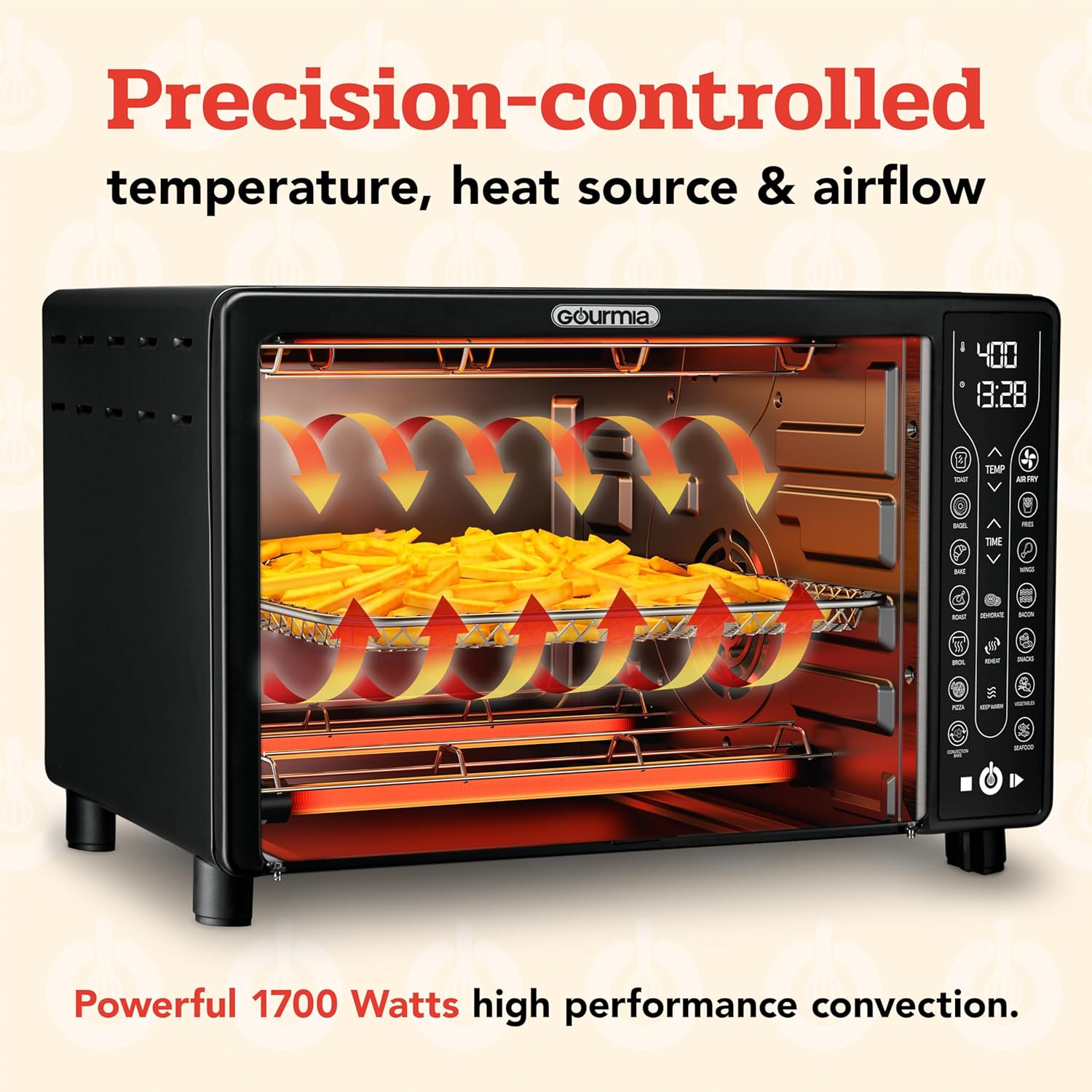
Power and method conspire to give you faster cooking than a conventional oven, and often better crispness than a standard toaster oven. The 1700W unit heats quickly and uses directed airflow to remove the sogginess that torments many reheated foods.
You will be pleasantly surprised by how well fries, wings, and breaded items come out without a lake of oil. Roasts achieve good browning; bakes require a watchful eye but generally reward patience.
Air-frying results
Air-fried items will often arrive at your plate with a satisfying crunch and a moist interior. You will taste less oil and more texture, which can feel like a small triumph in your ongoing relationship with food and caloric math.
Some foods will still benefit from a slight brush of oil to help with color and conductance—air frying is not a miraculous vacuum that rescues every preparation. Think of it as a more efficient frying cousin: it can do wonders if you respect its rules.
Baking and roasting
The Gourmia handles small bakes with a good degree of evenness. Cookies, small cakes, and roasted vegetables brown well, although you will want to rotate pans once or twice during longer bakes to avoid hot spots.
Roasts develop a pleasant crust, and the convection helps shorten cook time compared to a conventional oven. Keep an eye on internal temperatures for poultry and pork; the oven will brown the outside while you monitor the inside with a probe.
Convection and FryForce technology
FryForce is the marketing name for a convection scheme that moves air vigorously to promote crispness. You will notice reduced need for oil and a tendency for surfaces to caramelize without burning the interiors.
However, aggressive convection can sometimes dry the surface of delicate items. You will learn when to lower the temp a little, and to cover with foil when you crave tenderness over an aggressive crust.
Presets and flexibility
Presets are like recipes with training wheels: helpful until you want to refine technique. The 17 preset options simplify decisions, offering a reliable place to start for common preparations.
You will quickly personalize them—tweaking times, nudging temperatures, and sometimes turning off the preset altogether in favor of manual control. The presets are most useful when you want dinner on the table without an evening of experimentation.
Using the 17 presets
The presets include modes for air frying, baking, broiling, roasting, dehydrating, and toasting among others. They are tuned for typical items and typical weights, meaning you will still need to adapt for thickness, starting temperature, and whether you prefer a gentler or fiercer finish.
Rely on them for weeknight confidence, but treat them as menus that can be rewritten. They are less an inflexible law than an educated suggestion.
Adjusting time and temperature
With a 1–99 minute timer and 90°F–450°F range, you have a wide envelope of control. You will fine-tune more than you expect: a few degrees lower for gentle baking, a few minutes longer for denser roasts.
Familiarize yourself with typical times for what you cook most often; you will then nudge presets into ones that reliably suit your taste.

This image is property of Amazon.com.
Accessories and what they bring to the table
The included stainless steel fry basket, baking pan, oven rack, and crumb tray are not accessories for display: they are practical tools that make the unit usable from day one. The recipe book is a polite companion—suggestive and encouraging.
You will appreciate the immediate readiness to air fry or bake without hunting for additional purchases. The metal basket is sturdy, the pan adequate for most tasks, and the rack stable.
Stainless steel fry basket
The basket allows crisping with ample airflow around food, preventing soggy undersides that plague flat trays. You will find it excellent for fries, nuggets, and small roasted vegetables.
It is also easy to clean if you rinse promptly. Do not allow batter to harden on it—you will be less appreciative then.
Baking pan, rack, and crumb tray
The baking pan is good for roast vegetables and smaller sheet-baked items, while the rack provides elevated space for heat circulation. The crumb tray catches debris that would otherwise smoke or burn.
All these bits fit neatly and slide in without theatrics. You will sometimes wish for a second rack for parallel cooking, but the basic package is sensible and complete.
Cleaning and maintenance
Routine maintenance is simple: a wipe of the interior after cool-down, washing removable parts, and occasional deep clean for persistent grease. The crumb tray makes the difference between daily tidiness and a slow accumulation of burnt crumbs.
You will develop a habit quickly because a clean surface affects flavor and smoke levels. Regular cleaning is not a moral failing; it is an investment in consistent results.
How to clean the interior
Unplug and cool the oven, then wipe with a damp cloth and mild detergent for most residues. For stubborn baked-on grease, a paste of baking soda and water applied for 15–30 minutes will lighten the work of scrubbing.
Avoid abrasive scouring pads on non-stick surfaces; treat the enamel with respect and it will respond. You will find that small, frequent cleanings are better than heroic Sunday afternoon scrubbing.
Cleaning accessories
Most accessories are dishwasher-safe, but hand washing extends their life. The fry basket benefits from a soak if needed, and the baking pan will perform longer if you avoid harsh scouring.
You will also want to dry what you wash before storing; moisture and metal are secret conspirators against longevity.
This image is property of Amazon.com.
Safety and energy considerations
At 1700W the oven uses less energy than a full-sized electric range, but more than a microwave. It is not a silent appliance; expect warmth and airflow, and give it counterspace with breathing room.
Your safety practices—using oven mitts, not placing it near curtains, and supervising the appliance—matter. The design includes automatic shutoff features and heat insulation where it matters, but nothing replaces common sense.
Built-in safety features
The oven includes automatic shutoff timers, thermal protection and a design that reduces accidental contact with hot elements. You will still use mitts and respect the heat.
The French door reduces the risk of spillage compared to a heavy drop-down door, but both doors can be hot after long cooking times. Mind the hinges and the way hot air exits when you open them.
Power use and kitchen placement
1700W is substantial for a countertop appliance; you will be aware of it if you live in a home with delicate electrical balances. Avoid running multiple heavy appliances on the same circuit simultaneously.
Place the unit on a stable surface with clearance on all sides and an absence of flammable materials. The machine will give off heat during and after cooking, so allow it some dignity and space.
User experience and everyday use
You will find the appliance quick to heat and forgiving in routine use. It simplifies weeknight dinners and rescues leftovers with more charm than a microwave and less drama than the oven.
There will be a learning curve—how your pans brown, which preset does what—but once you have learned, the oven becomes an ally rather than a taskmaster.
Noise and heat during operation
The convection fan is honest about its presence; you will hear a steady hum that denotes action rather than idle chatter. The unit grows warmer externally than a microwave, so keep it clear of clutter.
The fan noise is non-intrusive and generally masked by the sounds of daily life. If your kitchen is very quiet, the hum becomes a kind of domestic metronome.
Ease of use and learning curve
Setting timers and toggling presets is straightforward, and within a week you will have a list of go-to settings. Cooking is a conversation between you and the appliance; it will answer best when you listen.
Expect to make small adjustments early on. You will find the rhythm: a degree lower here, three minutes more there, and then you will achieve consistently satisfying food.
This image is property of Amazon.com.
Pros and cons
You will want to weigh the practical advantages against the limitations; this list helps you do that quickly and fairly.
Pros:
- Generous 24L capacity that fits a 12″ pizza and a whole chicken.
- 1700W power with FryForce Convection for crisp, quick results.
- 17 presets reduce guesswork and speed up meal prep.
- French door design makes loading and unloading easier.
- Useful accessories included: stainless steel fry basket, baking pan, rack, crumb tray, and recipe book.
Cons:
- Can be bulky on a small countertop and needs clearance.
- Convection can sometimes over-dry delicate items if not adjusted.
- Presets can be generic; manual adjustments will often be necessary.
- Not a replacement for a full-sized oven for large-batch baking.
You will find that the pros outnumber the cons for many households, particularly those valuing speed, convenience, and crispness without a deep dependence on oil.
How it compares to other appliances
Compared to a conventional oven, you will save time and energy on small to medium tasks. Compared to dedicated air fryers, you get more versatility and the option of baking and roasting in a properly enclosed space.
If you have a limited counter, the size might sway you toward a smaller basket-only air fryer, but the Gourmia gives you more flexibility if you cook varied meals for more than one person.
Vs. conventional oven
You will save time preheating and a substantial portion of the energy used for small cooks. Roasting time is often shorter with convection, and the results—especially for crisping—are competitive.
On the other hand, a conventional oven gives you size and the ability to bake multiple racks of cookies without compromise. If you often entertain large groups, the Gourmia serves as a companion rather than a replacement.
Vs. single-function air fryers
The Gourmia offers broader capabilities. You will bake, dehydrate, broil, and toast in addition to air frying, which lowers the need for multiple gadgets.
A basket-only air fryer can be slightly speedier for certain single-dish tasks, and it may fit in smaller kitchens. If you value multifunctionality and space for a 12″ pizza or a whole chicken, the Gourmia is the better single-appliance choice.
Practical cooking tips
You will get more from the appliance when you adopt a few habits: preheat when necessary, arrange food to allow airflow, and check internal temperatures. A thermometer will become your most trusted ally.
Small habits—brushing food with a light coat of oil, rotating trays, and using the rack for elevation—make a profound difference.
Preheating and loading
Preheat for crisping tasks; the digital display counts down, and the oven reaches temperature quickly. Load food so that air can circulate: single layers when possible, and space between pieces for even browning.
Do not be shy about rotating pans half-way through baking. You will see more even results when you do.
Oil and seasoning
A light spritz of oil on fries or breaded items helps with color and prevents dryness, while heavy oils give you less advantage over traditional frying. Season after cooking for delicate herbs that can scorch.
You will find that finishing salts and spices added post-cook elevate texture and flavor more than kitchen hand-wringing.
Recipe ideas and timing guidelines
You will be tempted to experiment, and you should. Below are starting points for common items—adjust for your particular oven, altitude, and taste.
Crispy fries (frozen)
Toss frozen fries lightly in oil, spread in a single layer in the fry basket, set to air fry at 400°F for 12–18 minutes, shaking halfway. You will get a golden exterior and tender interior without a vat of oil.
Check after 10 minutes to learn how your fries behave and adjust future runs accordingly.
Whole chicken roast
Season a 3–4 lb chicken, place on the rack, roast at 375°F convection for 45–60 minutes until internal temperature reaches 165°F in the thigh. You will achieve browned skin and juicy meat if you allow rest before carving.
A tent of foil for the last 10 minutes can prevent over-browning if needed.
12-inch pizza
Preheat to 425°F and bake for 10–15 minutes, depending on crust thickness and topping weight. You will get a crisp crust and melted cheese more quickly than in many conventional ovens.
A pre-baked crust or par-baked dough often gives the best results for uniform crispness.
Dehydrated fruit
Set to dehydrating mode around 135°F–145°F and dry apple slices or banana chips for 6–12 hours, flipping occasionally. You will have small, healthy snacks and control over sugar and additives.
Monitor the first batch to find the sweet spot between chewiness and brittle crunch.
Toast and bagels
Toast at preset settings for 3–6 minutes depending on desired darkness. You will appreciate toasted bread with even browning and a crisp edge.
For bagels, split and toast cut-side down for best results.
Troubleshooting and frequently asked questions
You will run into small puzzles. Here are answers to likely questions that will save you a moment of confusion and perhaps a little exasperation.
Why is my food browning too quickly?
Convection and high temperatures drive quicker browning. You will lower the temperature by 15–25°F and increase time slightly to allow the interior to catch up.
Consider tenting with foil if the surface is done but the inside is undercooked.
My appliance is smoking—what now?
Grease or crumbs are the usual culprits. Unplug, let cool, remove the crumb tray and accessories for cleaning, and run again after a wipe. If smoke persists, perform a deeper clean and check for drips on heating elements.
You will learn to preempt smoke by wiping spills and using the crumb tray diligently.
How do I avoid soggy foods?
Prevent sogginess by not overcrowding the basket and by using elevated racks to allow airflow beneath. A short preheat and high finish temperature encourages crispness.
You will also pat meats and vegetables dry before oiling and seasoning to encourage efficient browning.
Maintenance, warranty, and long-term care
You will want to register the product and keep receipts if the warranty becomes relevant. Normal care extends life: avoid metal utensils on non-stick surfaces, don’t block vents, and store the unit dry and clean.
If you treat the oven as a daily tool with occasional respect, it will serve you reliably for years.
Warranty and support
Check the included documentation for specifics on the warranty. Gourmia typically offers a limited warranty; you will register online to ensure coverage and to access support.
Keep your purchase details and serial number in a safe place; they will be useful if repairs or replacement parts are ever required.
Long-term tips
Replace the crumb tray liner if it becomes warped, and consider buying an extra baking pan for parallel cooking needs. You will also find that a silicone mat for the baking pan can reduce cleanup time and preserve the pan surface.
Routine attention extends the life of any appliance; this is true here as in the rest of your kitchen ecosystem.
Final verdict
You will find the Gourmia Toaster Oven Air Fryer Combo 17 cooking presets 1700W french door digital air fryer oven 24L capacity accessories, convection rack, baking pan tray recipe book GTF7460,Large,Black to be a capable, flexible, and well-priced countertop companion. It is not a perfect replacement for a full-sized oven, but it is a remarkably competent servant for daily meals, reheats, and small roasts.
If you cook for two to four people and value crispness, simplicity, and a measure of technological courtesy, this unit rewards attention and modest experimentation. The French doors, FryForce convection, and included accessories make it an appliance you will use often and, perhaps surprisingly, enjoy.
Quick checklist before you buy
You want to be certain before altering your countertop dynamics. Here are practical decisions you can make now.
- Measure counter space and ensure 2–3 inches clearance on sides and back.
- Check your circuits if you have multiple high-watt devices in the kitchen.
- Consider whether the 24L capacity matches your regular meal sizes.
- Decide whether you want the multifunctionality to replace or complement existing appliances.
You will make the best choice when you match the machine to your habits and priorities rather than to its promise alone. If you are after convenience without sacrificing texture, this Gourmia model is a persuasive argument.
A few closing thoughts
You will, in time, form rituals around any frequently used appliance: a favored preset, a ritual wipe, the secret pan you prefer. The Gourmia GTF7460 invites those rituals with competence and minimal fuss. Its voice in your kitchen will be practical and mildly triumphant as it presents browned edges and warmed centers—small, daily victories that matter more than the sum of their parts.
Disclosure: As an Amazon Associate, I earn from qualifying purchases.